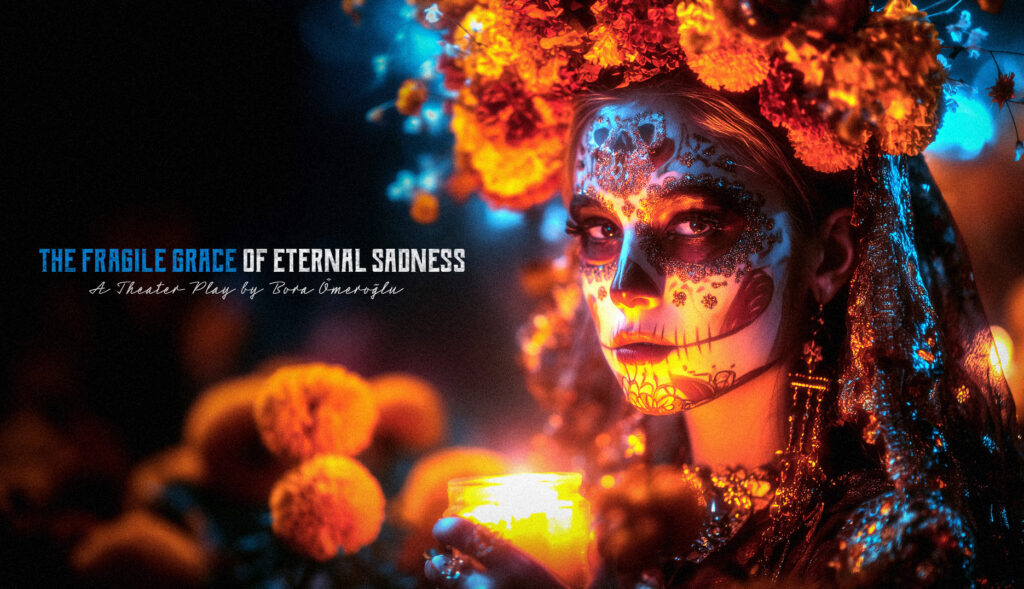
The Fragile Grace of Eternal Sadness
Playwright | Director | Producer
The Fragile Grace of Eternal Sadness | Play Intro Video Art
© All Rights Reserved
A Theatrical Work by Bora Ömeroğlu
Lost
Stand still. The trees ahead and bushes beside you
Are not lost. Wherever you are is called Here,
And you must treat it as a powerful stranger,
Must ask permission to know it and be known.
The forest breathes. Listen. It answers,
I have made this place around you.
If you leave it, you may come back again, saying Here.
No two trees are the same to Raven.
No two branches are the same to Wren.
If what a tree or a bush does is lost on you,
You are surely lost. Stand still. The forest knows
Where you are. You must let it find you.
by David Wagoner
The Bible
Overview
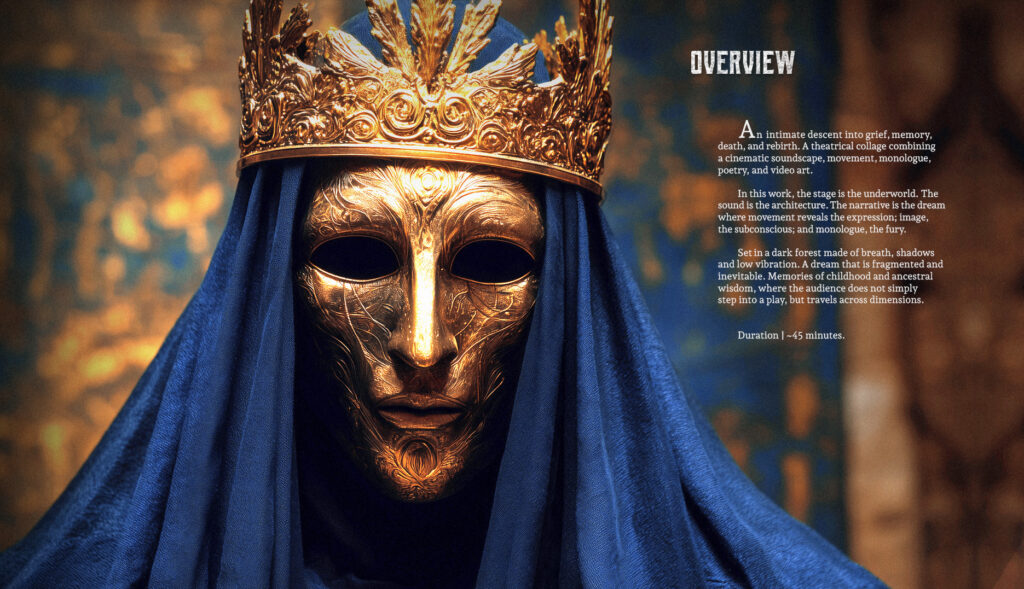
An intimate descent into grief, memory, death, and rebirth. A theatrical collage combining a cinematic soundscape, movement, monologue, poetry, and video art.
In this work, the stage is the underworld. The sound is the architecture. The narrative is the dream where movement reveals the expression; image, the subconscious; and monologue, the fury.
Set in a dark forest made of breath, shadows and low vibration. A dream that is fragmented and inevitable. Memories of childhood and ancestral wisdom, where the audience does not simply step into a play, but travels across dimensions.
Duration | ~45 minutes
Synopsis
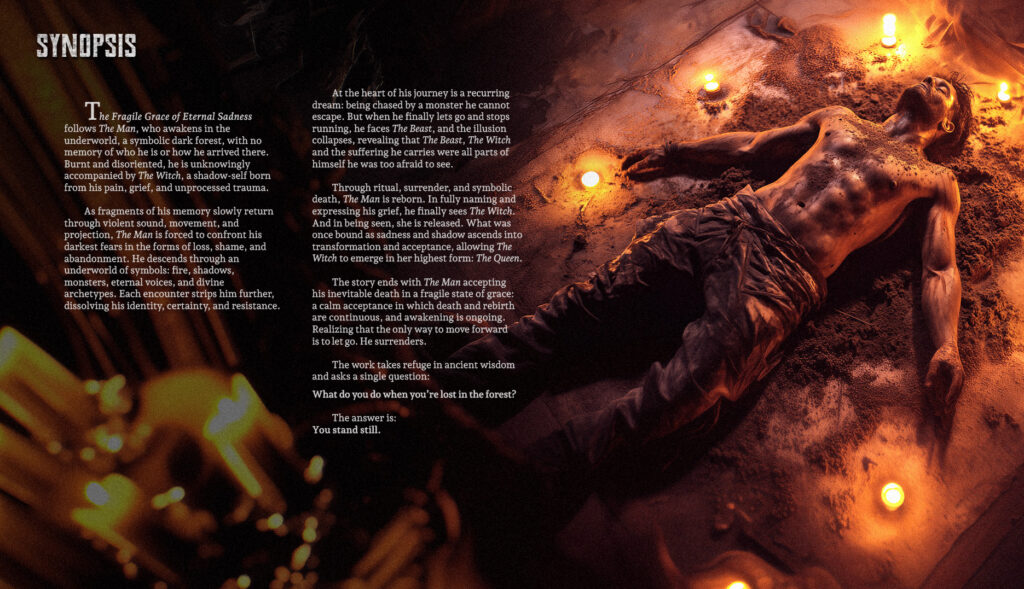
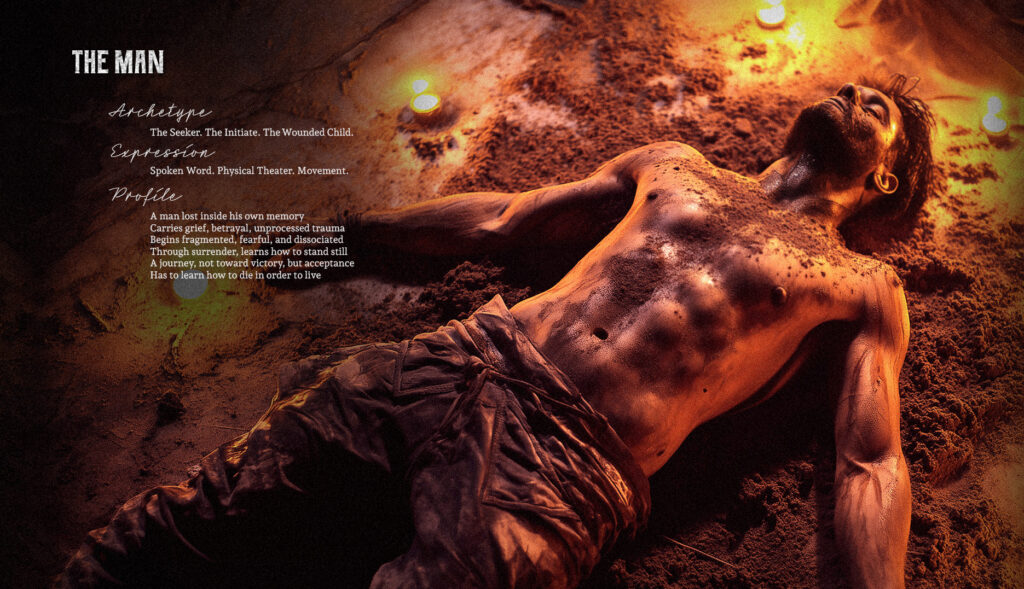
The Fragile Grace of Eternal Sadness follows The Man, who awakens in the underworld, a symbolic dark forest, with no memory of who he is or how he arrived there. Burnt and disoriented, he is unknowingly accompanied by The Witch, a shadow-self born from his pain, grief, and unprocessed trauma.
As fragments of his memory slowly return through violent sound, movement, and projection, The Man is forced to confront his darkest fears in the forms of loss, shame, and abandonment. He descends through an underworld of symbols: fire, shadows, monsters, eternal voices, and divine archetypes. Each encounter strips him further, dissolving his identity, certainty, and resistance.
At the heart of his journey is a recurring dream: being chased by a monster he cannot escape. But when he finally lets go and stops running, he faces The Beast, and the illusion collapses, revealing that The Beast, The Witch and the suffering he carries were all parts of himself he was too afraid to see.
Through ritual, surrender, and symbolic death, The Man is reborn. In fully naming and expressing his grief, he finally sees The Witch. And in being seen, she is released. What was once bound as sadness and shadow ascends into transformation and acceptance, allowing The Witch to emerge in her highest form: The Queen.
The story ends with The Man accepting his inevitable death in a fragile state of grace: a calm acceptance in which death and rebirth are continuous, and awakening is ongoing. Realizing that the only way to move forward is to let go. He surrenders.
The work takes refuge in ancient wisdom and asks a single question:
What do you do when you’re lost in the forest?
The answer is: You stand still.
Visual World & Characters
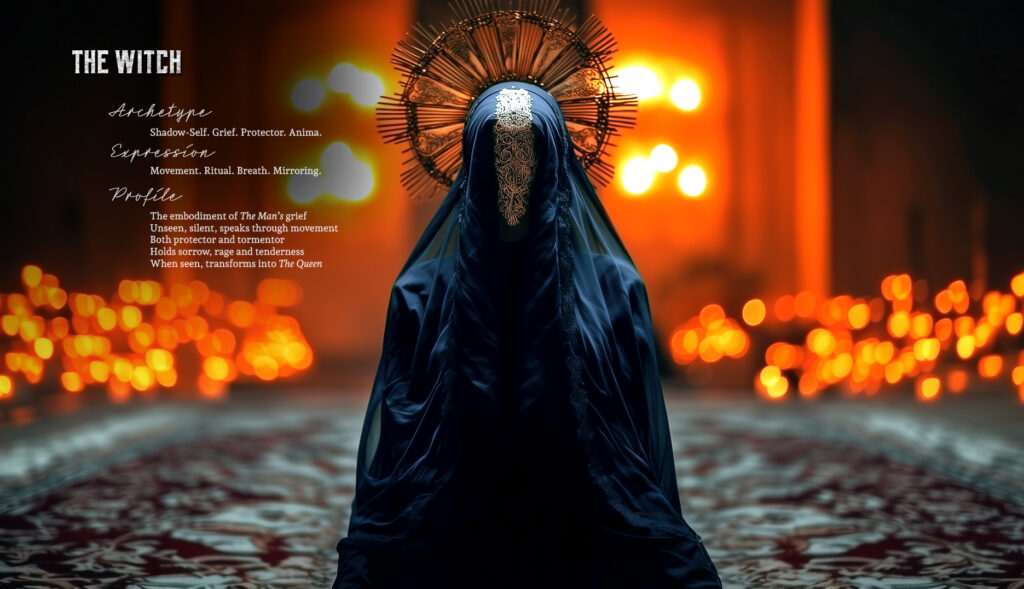
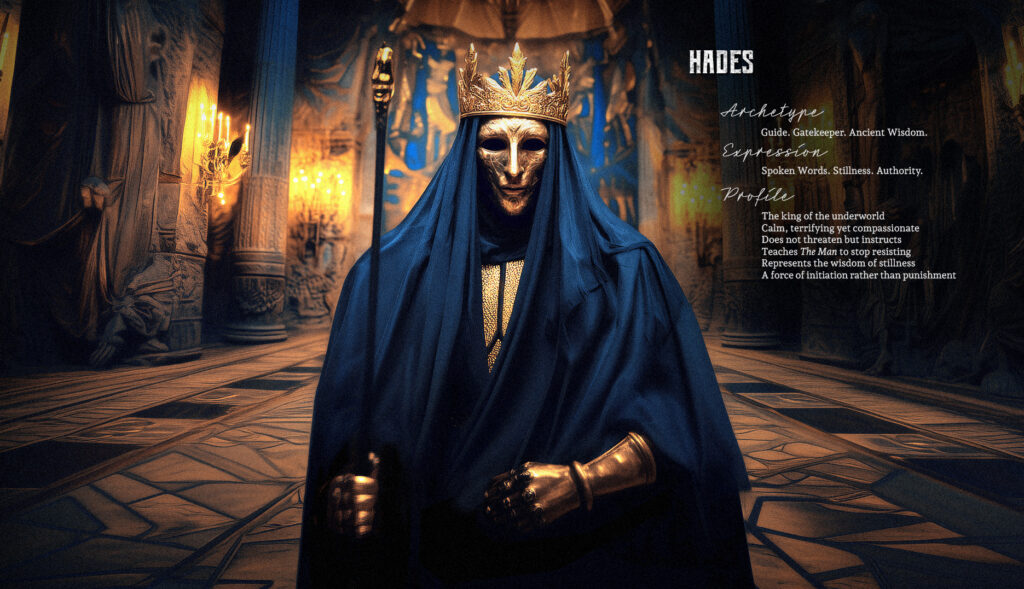
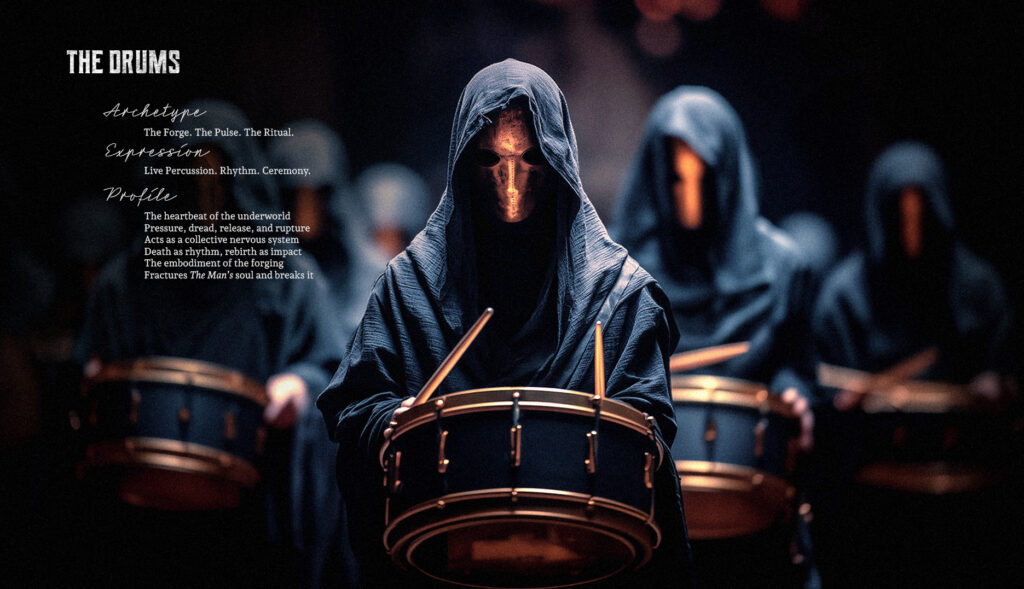
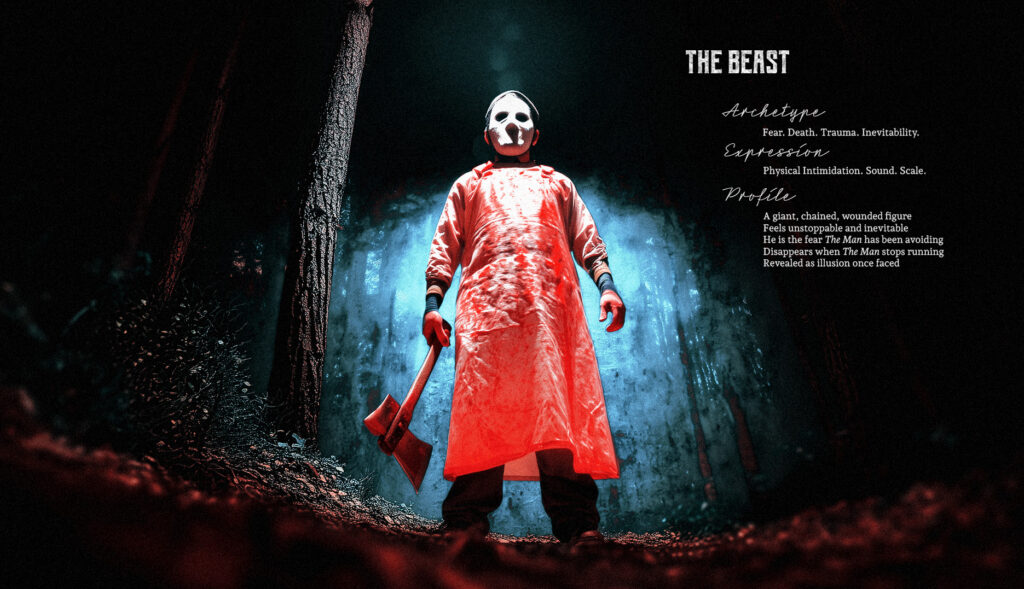

Artist’s Vision
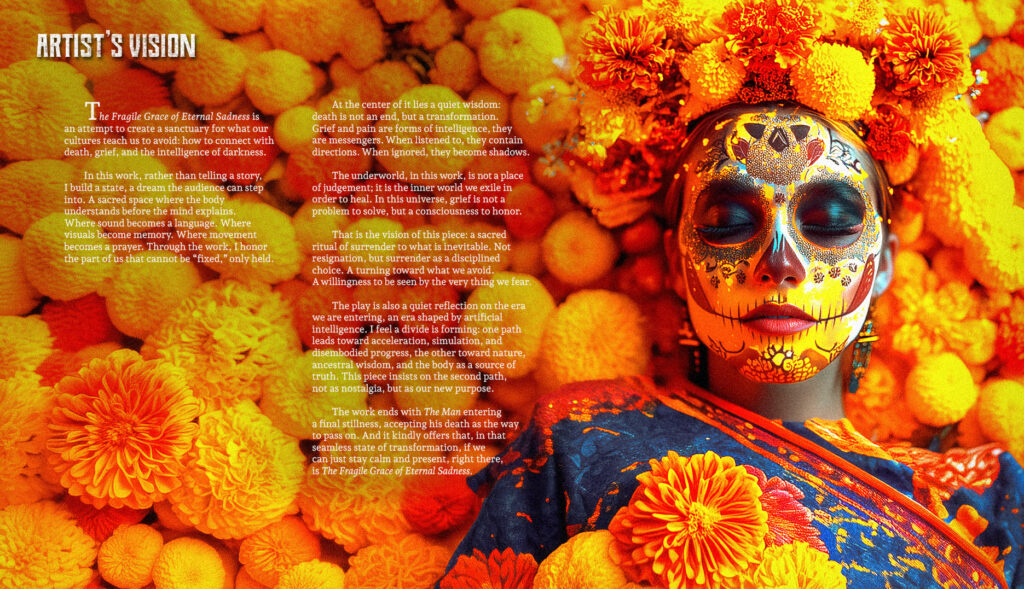
The Fragile Grace of Eternal Sadness is an attempt to create a sanctuary for what our cultures teach us to avoid: how to connect with death, grief, and the intelligence of darkness.
In this work, rather than telling a story, I build a state, a dream the audience can step into. A sacred space where the body understands before the mind explains. Where sound becomes a language. Where visuals become memory. Where movement becomes a prayer. Through the work, I honor the part of us that cannot be “fixed,” only held.
At the center of it lies a quiet wisdom: death is not an end, but a transformation. Grief and pain are forms of intelligence, they are messengers. When listened to, they contain directions. When ignored, they become shadows.
The underworld, in this work, is not a place of judgement; it is the inner world we exile in order to heal. In this universe, grief is not a problem to solve, but a consciousness to honor.
That is the vision of this piece: a sacred ritual of surrender to what is inevitable. Not resignation, but surrender as a disciplined choice. A turning toward what we avoid. A willingness to be seen by the very thing we fear.
The play is also a quiet reflection on the era we are entering, an era shaped by artificial intelligence. I feel a divide is forming: one path leads toward acceleration, simulation, and disembodied progress, the other toward nature, ancestral wisdom, and the body as a source of truth. This piece insists on the second path, not as nostalgia, but as our new purpose.
The work ends with The Man entering a final stillness, accepting his death as the way to pass on. And it kindly offers that, in that seamless state of transformation, if we can just stay calm and present, right there, is The Fragile Grace of Eternal Sadness.
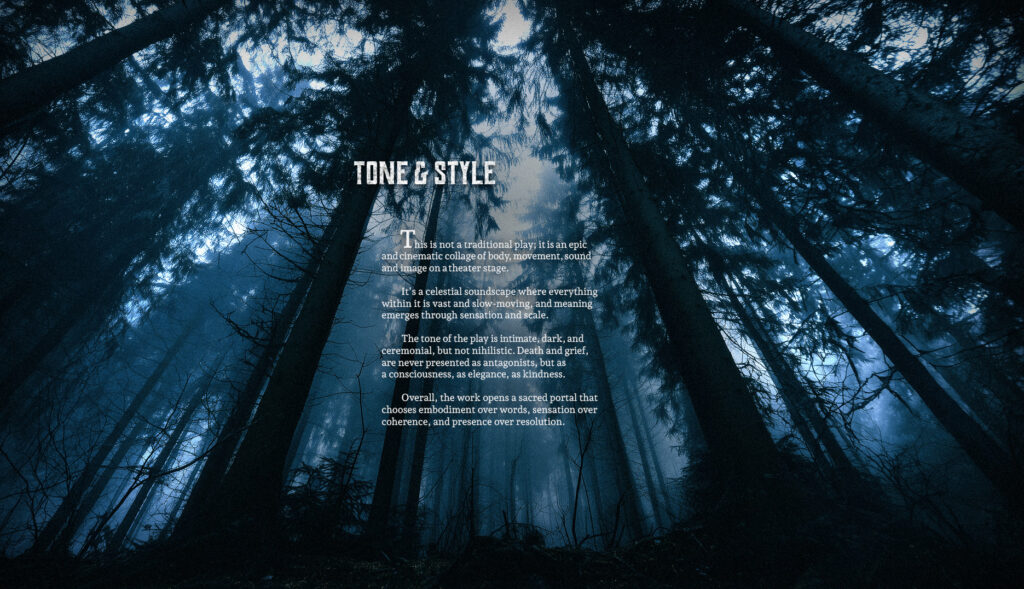
Tone & Style
This is not a traditional play; it is an epic and cinematic collage of body, movement, sound and image on a theater stage.
It’s a celestial soundscape where everything within it is vast and slow-moving, and meaning emerges through sensation and scale.
The tone of the play is intimate, dark, and ceremonial, but not nihilistic. Death and grief, are never presented as antagonists, but as a consciousness, as elegance, as divine.
Overall, the work opens a sacred portal that chooses embodiment over words, sensation over coherence, and presence over resolution.

My deepest gratitude to everyone involved…
| Client: | Original Concept |
| Date: | February 10, 2026 |